
History of OpenAI
OpenAI, the creator of ChatGPT, is one of the most recognizable companies in the modern technology landscape. While we have come to embrace “Chat” as our assistants, researchers, proofreaders, and brainstorming partners, it took a significant amount of time, money, and governance changes to get to this point.
OpenAI was founded in 2015 by Greg Brockman, Ilya Sutskever, Elon Musk, and Sam Altman.¹ From the company’s inception in 2015, its “goal [was] to advance digital intelligence in the way that is most likely to benefit humanity as a whole, unconstrained by a need to generate financial return.”² Specifically, looking at the sentiment of “unconstrained by a need to generate financial return,” it immediately signals nonprofit status, and yes, the original OpenAI was (and still kind of is) a 501(c)(3). However, years of legal battles, unusual corporate structures, and the need to raise capital have significantly changed that original hierarchy, leading to one of the more complicated governance situations in recent history.
In 2019, to raise capital for the substantial resources required to train its models, OpenAI launched a for-profit subsidiary.³ This subsidiary, known in 2019 as the OpenAI Limited Partnership (LP), was considered a hybrid “capped-profit” company, where investors had a limit on how much their returns could amount to.⁴ In most reported cases, this limit gave investors the ability to earn up to one hundred times their original investment, but this number was reduced significantly over time. As an example, Microsoft’s investment deal in 2019 was capped at a 20x return, and by 2021, the cap generally had fallen to single digits.⁵
Here is how this “capped-profit” structure appeared:
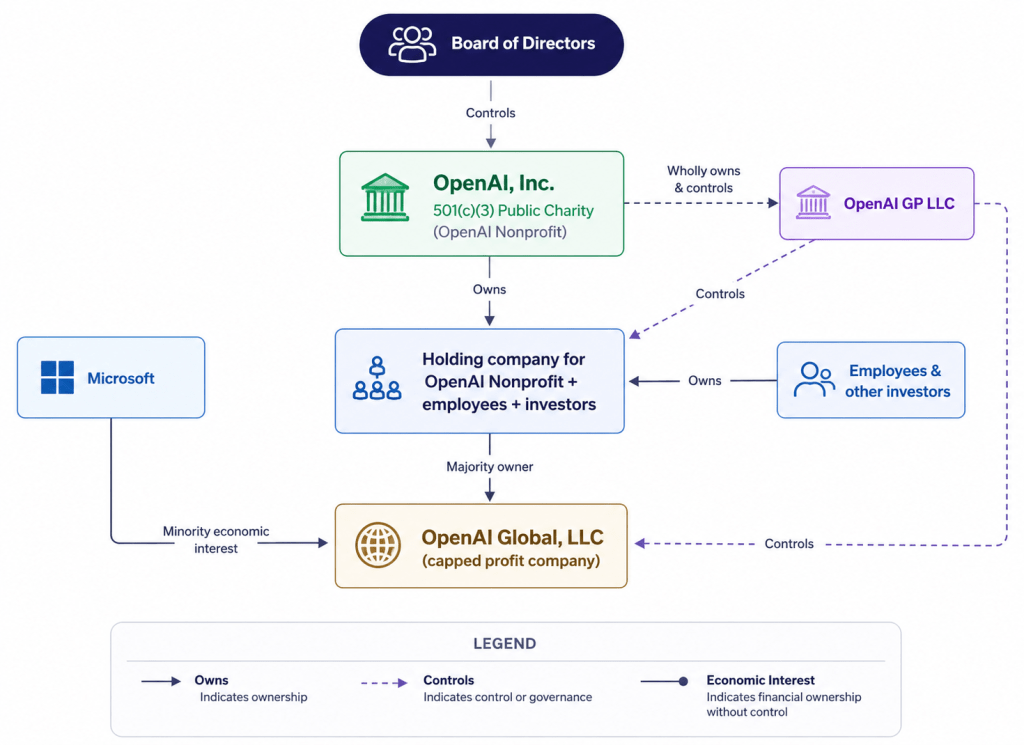
As time went on, this “capped” structure proved to be unsustainable, culminating in the widely publicized firing and rehiring of Altman. At the time of his termination, the OpenAI nonprofit board controlled the for-profit arm and, consequently, voted to oust Altman.⁶ While little was revealed regarding his firing, it subsequently set the internet ablaze with theories, market speculation, and unrest spinning out of control. Immediately after the news broke, those with financial interests began to intervene, and within 5 days, Altman was brought back as Microsoft, Tiger Global, and Thrive Capital (all investors in OpenAI LP) pushed for his return.⁷ It is also important to note the additional influence of the company’s employees, as on the Monday following the firing, more than 700 of OpenAI’s approximately 800 employees signed a letter stating that they would resign and move to Microsoft with Altman if he did not return.⁸
At the end of the ordeal, anti-Altman board members were relieved of their duties, and new control and leadership were put into place. Now, from a nonprofit perspective, it is important to analyze the decision-making process behind Altman’s reinstatement. For investors in the “capped-for-profit subsidiary,” the question ultimately becomes: what kind of power should these investors have had over the nonprofit board’s decision? At the time, Microsoft had already invested more than $11 billion into the for-profit arm, but how does that work with the fiduciary duties of board members to prioritize the mission over profit? Was it a conflict of interest?
As stated, Altman and OpenAI’s new board of directors began developing a different structure, which evolved over the next two years.⁹ Altman, with the support of Microsoft, quickly got to work on expansion, scaling, and changing the original governance situation, as it became clear that it stifled the funding needed to grow at the intended rate.
October 2025
As those two years passed, so began the advent of competitors, the widespread use of AI, and the continued investment of billions of dollars into the global technology sector. At the end of 2025, OpenAI finally announced the completed restructuring, with the end result ultimately including a for-profit structure.¹⁰ In this October 2025 chart, the nonprofit arm (now known as the OpenAI Foundation) owns 26% of the OpenAI Group, the new for-profit public benefit corporation that produces and operates ChatGPT and other related products.¹¹ Regarding the rest of the shares, Microsoft now owns 27%, employees own 26%, and the remainder is owned by other, smaller stakeholders.¹²
In an effort to retain the original “mission-first” mindset, the Foundation now has special voting and governance rights that override the equity division. Essentially, this provision gives the Foundation board the power to appoint and remove directors of the OpenAI Group at any time, even though Microsoft technically holds the largest ownership stake.¹³ Here is a current diagram of how things worked as of October 2025:
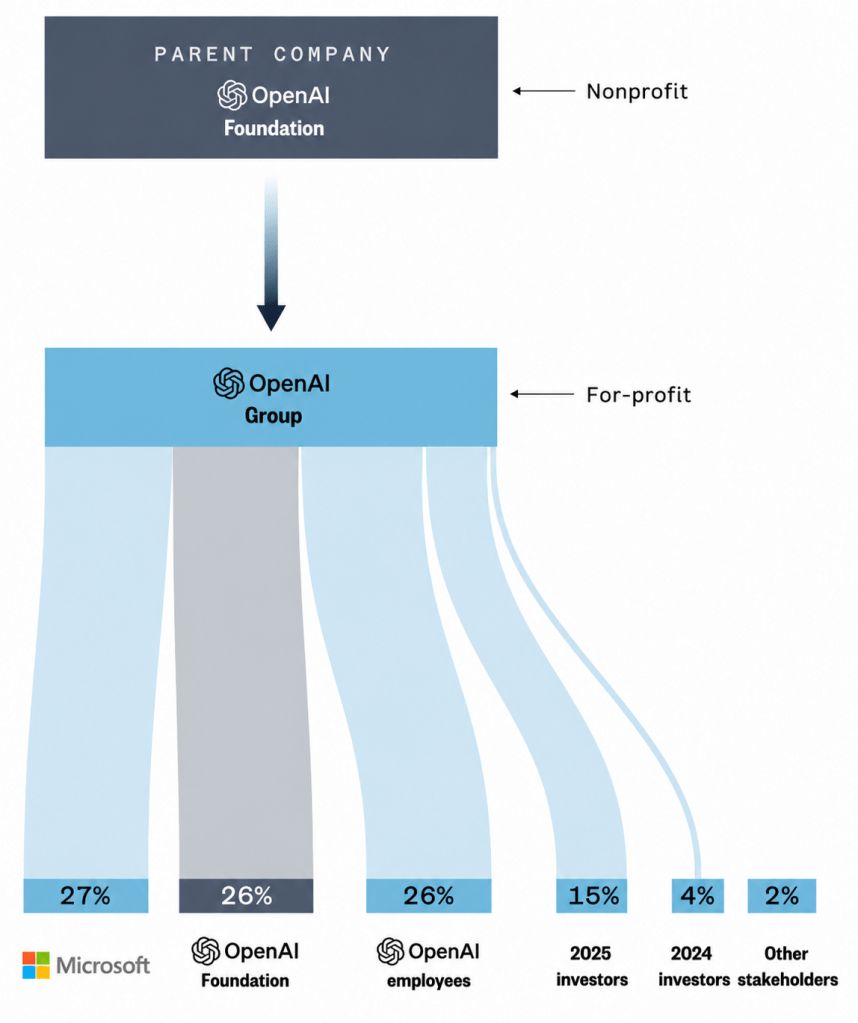
This compromise unfortunately paves the way for conflict regarding board control, as the fiduciary duties of nonprofit and for-profit board directors differ. Unlike a for-profit company, the priority and legal responsibilities of the board of directors of a nonprofit are to advance the organization’s charitable mission rather than maximize shareholder value. This new setup will show how a mission-aligned board handles decisions regarding a massive for-profit arm, possibly setting precedent for years to come. It is important to note that many nonprofits do have small businesses that mirror a similar setup; however, these businesses are often auxiliaries and not Fortune 500 companies.
To combat these concerns, as mentioned, the OpenAI Group became a public benefit corporation, meaning it “[operates] in a responsible and sustainable manner while also pursuing one or more specified public benefits, in addition to generating profit for shareholders.”¹⁶ While this categorization is a beneficial step, it presents room for non-alignment, as the OpenAI Group may have difficulty prioritizing objectives. Overall, as a result of this complex structure, questions about the legality, duties, and operations of the organization will surely ensue and eventually set precedent for future organizations.
More Changes & The Future
More changes are expected to come, as within the past month, OpenAI announced that it would begin preliminary IPO processes to become a publicly traded company. Fresh off a jury verdict against Elon Musk’s lawsuit, which unsuccessfully challenged the legality of OpenAI’s governance structure, OpenAI publicly indicated its intention to go public.¹⁴
In conjunction with these plans, CNBC reported that OpenAI was preparing to confidentially file a draft IPO prospectus in 2026.¹⁵ Now, the governance situation will change yet again, with a transition into OpenAI being a publicly traded company with more institutional shareholders. Immediately, concerns are surfacing about who will influence decisions, where the new shares will come from (possibly via dilution of other shares), how the Foundation board’s 26% equity stake and control will be affected, and how open stock trades and large investors will interact with the nonprofit’s mission statement.
Furthermore, questions regarding conflicts of interest, investor influence, and the fiduciary obligations of nonprofit directors, combined with the now extensive expansion of the AI sector, continue to raise questions about OpenAI’s future and the power corporations have to blend governance structures. As this process continues, we will look to see how the courts, the SEC, and partnering institutions react to an OpenAI governance structure that intends to integrate a mix of “humanity-first” and “shareholder value” ideologies into one of the world’s most important companies.
References
- Montevirgen, K. (2026, May 28). OpenAI | ChatGPT, Sam Altman, & Microsoft. Britannica Money. Encyclopaedia Britannica. https://www.britannica.com/money/OpenAI
- Brockman, G., Sutskever, I., & OpenAI Team. (2015, December 11). Introducing OpenAI. OpenAI. https://openai.com/index/introducing-openai/
- Tuininga, S. (2026, February 10). Profits and nonprofits: The odd evolution of OpenAI. Capital Research Center. https://capitalresearch.org/article/profits-and-nonprofits-the-odd-evolution-of-openai/
- The Midas Project & Tech Oversight Project. (2025). Restructuring concerns: OpenAI’s corporate structure. OpenAI Files. https://www.openaifiles.org/restructuring
- Tuininga, S. (2026, February 10). Profits and nonprofits: The odd evolution of OpenAI. Capital Research Center. https://capitalresearch.org/article/profits-and-nonprofits-the-odd-evolution-of-openai/
- Tarantola, A. (2023, November 17). OpenAI fires CEO Sam Altman as “board no longer has confidence” in his leadership. Engadget. https://www.engadget.com/openai-ceo-sam-altman-ousted-as-board-no-longer-has-confidence-in-his-leadership-204924006.html
- Goswami, R., & Novet, J. (2023, November 19). OpenAI investors push to bring Altman back as CEO one day after he was ousted. NBC News. https://www.nbcnews.com/news/us-news/openai-investors-push-bring-altman-back-ceo-one-day-was-ousted-board-rcna125884
- Perrigo, B. (2023, November 22). Sam Altman returns as OpenAI CEO. Here’s how it happened. Time. https://time.com/6338789/sam-altman-openai-return-timeline/
- Cogni Down Under. (2025, October 28). OpenAI’s new structure: Nonprofit controls $500B for-profit. Medium. https://medium.com/@cognidownunder/the-restructuring-everyone-missed-144459c6540c
- Perlo, J., & Wu, J. (2025, October 29). A nonprofit on top, billions below: Inside OpenAI’s new corporate balancing act. NBC News. https://www.nbcnews.com/tech/tech-news/openai-restructuring-company-structure-chatgpt-invest-own-rcna240138
- Tuininga, S. (2026, February 10). Profits and nonprofits: The odd evolution of OpenAI. Capital Research Center. https://capitalresearch.org/article/profits-and-nonprofits-the-odd-evolution-of-openai/
- Cogni Down Under. (2025, October 28). OpenAI’s new structure: Nonprofit controls $500B for-profit. Medium. https://medium.com/@cognidownunder/the-restructuring-everyone-missed-144459c6540c
- Cogni Down Under. (2025, October 28). OpenAI’s new structure: Nonprofit controls $500B for-profit. Medium. https://medium.com/@cognidownunder/the-restructuring-everyone-missed-144459c6540c
- Seetharaman, D., Stempel, J., & Bensinger, G. (2026, May 18). OpenAI defeats Elon Musk’s lawsuit, removes obstacle to IPO. Reuters. https://www.reuters.com/
- Capoot, A., & Rooney, K. (2026, May 20). OpenAI to confidentially file for IPO as soon as Friday: Source. CNBC. https://www.cnbc.com/2026/05/20/openai-ipo-filing.html
- BLegal Information Institute. (n.d.). Public benefit corporation. Wex. Cornell Law School. Retrieved June 2, 2026, from https://www.law.cornell.edu/wex/public_benefit_corporation
 CoffeyWritesImpact
Leave a comment