Accommodating Universally
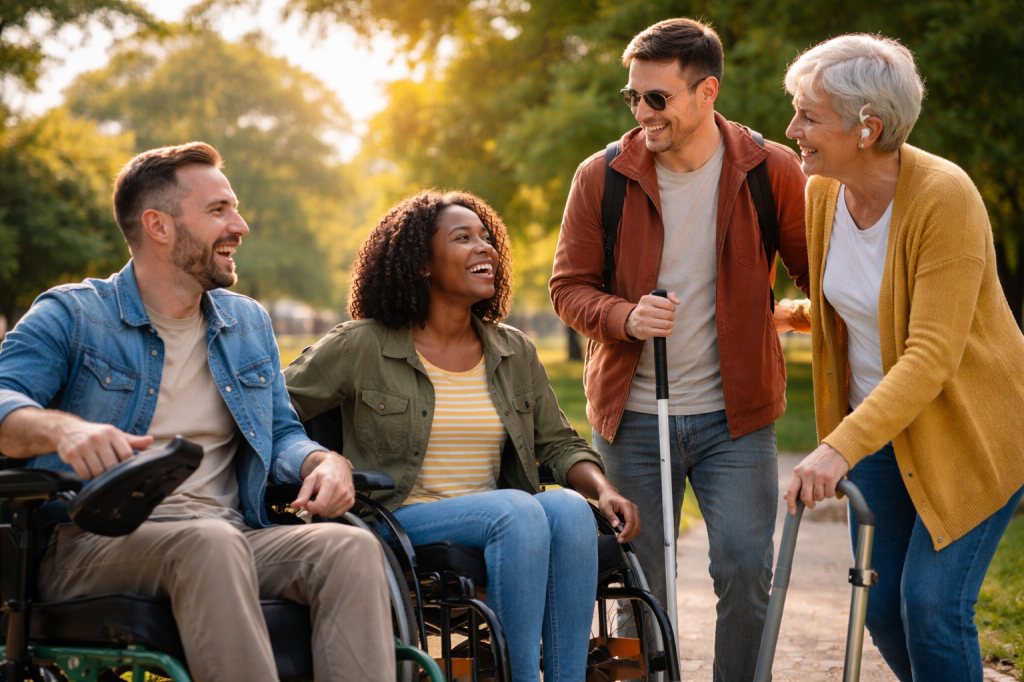
When people typically think of accommodations, the first images that come to mind may include speech devices, wheelchairs, or hearing aids. However, accommodations are now built into our society and actually benefit all. Remember when you used the wheelchair button to open the door when you had groceries? This process is called “Universal Design,” which is defined as organizing the environment so that it can be accessed by the greatest amount of people, regardless of their ability level.¹ The Americans with Disabilities Act, which is the main piece of legislation that supports Americans with disabilities, was actually just updated in 2024 and continues to promote Universal Design.²
These acts and regulations are essential in creating an accessible environment for the macro level, but it is up to local communities and governments to ensure that these protections are enacted. In the nonprofit sector, we must ensure that our programming is accessible to all people, as our job is to empower others. For instance, post 2024, nonprofits must ensure that their webpages are WCAG 2.2 (Web Content Accessibility Guidelines) compliant, which ensures their websites are readable by those who are visually and hearing impaired.³
The Importance of Accessibility
Currently, about 1 in 4 people in the United States have a disability, rounding out to approximately 70 to 80 million people.⁴ Furthermore, people with disabilities are more likely to be marginalized and experience financial insecurity than someone without a disability.⁵ Therefore, based on likelihood, nonprofits will see a large amount of constituents with disabilities and must ensure their programming is able to be used by all.
Every nonprofit should have an accessibility statement and contingency plans for events, as inaccessibility reinforces negative social conditions. Especially for adults with disabilities, many of these nonprofits provide community, friendship, and the tools needed to live independently.
Here are some steps that a nonprofit can take to ensure accessibility in opportunity and programming:
- Make sure that the location has a reasonably close parking lot or method of transportation.
- If food is provided, make sure dietary restrictions are taken into account.
- If information is presented, make sure there is accessible translation for those with visual or hearing impairments.
- If serving a population with IDD (Intellectual Disabilities), make sure the proper educational and behavioral processes are in place.
- Don’t make an assumption. It is okay to ask “how can we best accommodate you!”
Obviously, we have a long way to go until we reach universal accessibility. However, as many of the people we serve in nonprofits experience some form of disability, we must do our best to make our programming available to as many people as possible.
References
1. National Disability Authority. (2020). About universal design. https://universaldesign.ie/about-universal-design
2. U.S. Department of Justice, Civil Rights Division. (2024, April 24). Americans with Disabilities Act: Law and regulations. https://www.ada.gov/law-and-regs/
3. 501(c)(3) Organization. (2023, October 10). WCAG compliant nonprofit website: What you need to know. https://www.501c3.org/wcag-compliant-nonprofit-website/
4. Centers for Disease Control and Prevention. (2024, September 16). Disability impacts all of us infographic. https://www.cdc.gov/disability-and-health/articles-documents/disability-impacts-all-of-us-infographic.html
5. Lund, E. M., & Ayers, K. B. (2022, June 27). Raising awareness of disability financial inequity. Disability and Health Journal, 15(4), 101324. https://pmc.ncbi.nlm.nih.gov/articles/PMC9220755/
 CoffeyWritesImpact
Leave a comment