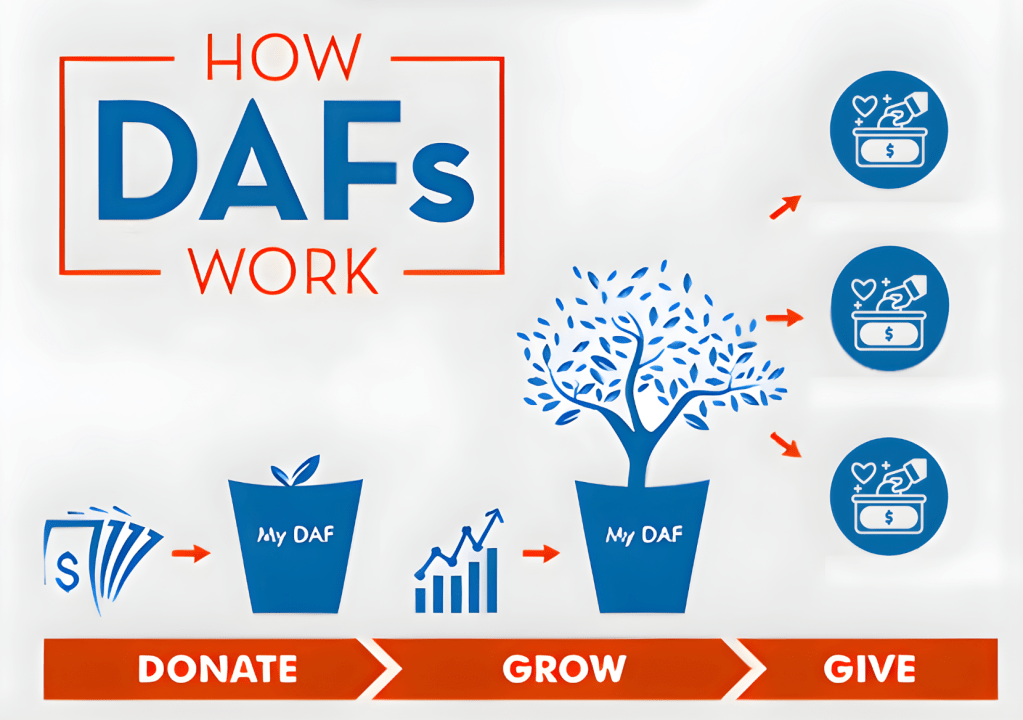
The principle of the time value of money states that money invested in a return-earning account is worth more than the present value of those dollars.¹ Basically, if you could put money into an account that accumulates returns over time, it is obviously advantageous to do so. In the charitable world, these devices are known as DAFs, or donor-advised funds. Essentially, if money is going to be held for a while before donation, then it should be accumulating returns in the market.
A donor-advised fund is an account that can receive cash, securities, and other assets.² Donors can then have input into where the grants from the fund will go.³ In 2023, there was approximately $54.8 billion in DAF grants, showing the growing number of people using these devices. The biggest question of all is: who actually owns these DAFs? Most are owned by large banking and investment companies that serve as “sponsoring organizations.”⁴ Essentially, the bank or investment company creates a nonprofit arm that manages the DAFs and allows donors to recommend which charities receive the money. In practice, funds move from a private donor account, to a bank-affiliated charitable organization (such as the Fidelity Charitable Gift Fund), and then to a 501(c)(3) charity based on the donor’s recommendation. Other common owners of DAFs are community foundations, which are public charities focused on specific geographic areas.⁵
DAFs make up a significant portion of philanthropic contributions and rank among the top three sources of charitable giving overall. Fidelity Charitable Gift Fund, National Philanthropic Trust, and Schwab Charitable are consistently at the top of the list, demonstrating the vast scale of DAF contributions.⁶ Banks benefit by gaining clients, increasing assets under management, and streamlining charitable giving. However, in recent years, there have been criticisms regarding the slow pace at which DAF funds are distributed. Adapted from a Forbes article, the following are suggested improvements for donors, sponsors, nonprofits, and government actors.⁷
- Donors should create explicit payout goals and timelines.
- Sponsors should establish default timelines, publish annual reports, and offer matching incentives.
- Nonprofits should be proactive with donors and encourage involvement.
- The government should consider implementing DAF payout requirements.
From a donor perspective, DAFs offer several advantages. Charitable dollars can grow through tax-free capital gains, donors can receive immediate tax deductions, and grantmaking can occur over many years.⁸ Donors may deduct contributions to DAFs up to 30% of adjusted gross income.⁹ The IRS also allows excess deductions to be carried forward for up to five years.¹⁰
Despite these benefits, DAFs face criticism for lacking payout requirements and for their dependence on market performance.¹¹ Additionally, DAFs are not required to engage in socially conscious investing, meaning investments are not necessarily aligned with environmental, social, and governance (ESG) priorities.¹² That said, more institutions are beginning to adopt these models. Overall, DAFs make it easier for donors to give, provide meaningful tax advantages, and encourage charitable participation. However, there is still a lot of animosity towards DAFs from the nonprofit community, rightfully so. Once again, banks and corporations have stepped in to dominate a field in an effort to accumulate market share. However, in a realism-based take and in our finance-dominated society, DAFs do offer a potential pathway to align institutional norms with social impact norms that can lead to advances in civil society. Progress may never be perfect, but it always important to understand new financial agents of change.
References
1. Investopedia. (2025, October 6). Time value of money (TVM).
https://www.investopedia.com/terms/t/timevalueofmoney.asp
2. Fidelity Charitable. (2025). What is a donor-advised fund?
https://www.fidelitycharitable.org/guidance/philanthropy/what-is-a-donor-advised-fund.html
3. National Philanthropic Trust. (2026, January). What is a donor-advised fund?
https://www.nptrust.org/what-is-a-donor-advised-fund/
4. National Philanthropic Trust. (2026, January). What is a donor-advised fund?
https://www.nptrust.org/what-is-a-donor-advised-fund/
5. Fidelity Charitable. (2025). Community foundations.
https://www.fidelitycharitable.org/guidance/philanthropy/community-foundations.html
6. Institute for Policy Studies. (2024, May 8). Top public charities sponsoring donor-advised funds. https://inequality.org/article/top-public-charities-dafs/
7. Forbes Nonprofit Council. (2025, August 26). DAFs were meant to move money. So why do they keep acting like banks https://www.forbes.com/councils/forbesnonprofitcouncil/2025/08/26/dafs-were-meant-to-move-money-so-why-do-they-keep-acting-like-banks/
8. National Philanthropic Trust. (2026, January). DAF tax considerations.
https://www.nptrust.org/what-is-a-donor-advised-fund/daf-tax-consideration/
9. National Philanthropic Trust. (2026, January). DAF tax considerations.
https://www.nptrust.org/what-is-a-donor-advised-fund/daf-tax-consideration/
10. DAF Giving 360. (2024). Publicly traded securities.
https://www.dafgiving360.org/non-cash-assets/publicly-traded-securities
11. Commonfund Institute. (2024, October 21). Top concerns for community foundations.
https://www.commonfund.org/research-center/articles/viewpoint-top-concerns-for-community-foundations
12. REN Investment Center. (2023, August 8). Investing for good: The power of DAFs and sustainable investing.
https://www.reninc.com/blog/investing-for-good-the-power-of-dafs-and-sustainable-investing/
 CoffeyWritesImpact
Leave a comment